In MIT’s OpenCourseWare Physics 8.04 course the professor poses walking through many values of k where only special values of k will satisfy the boundary conditions imposed upon us. For these problems I did not find good visualizations, and I wanted to make a good visualization of particle in a box / infinite square well problems. This is just a gif visualization of the boundary conditions in the well forcing energy quantization, and I have the assumption the reader is familiar with these infinite square well / particle in a box problems.
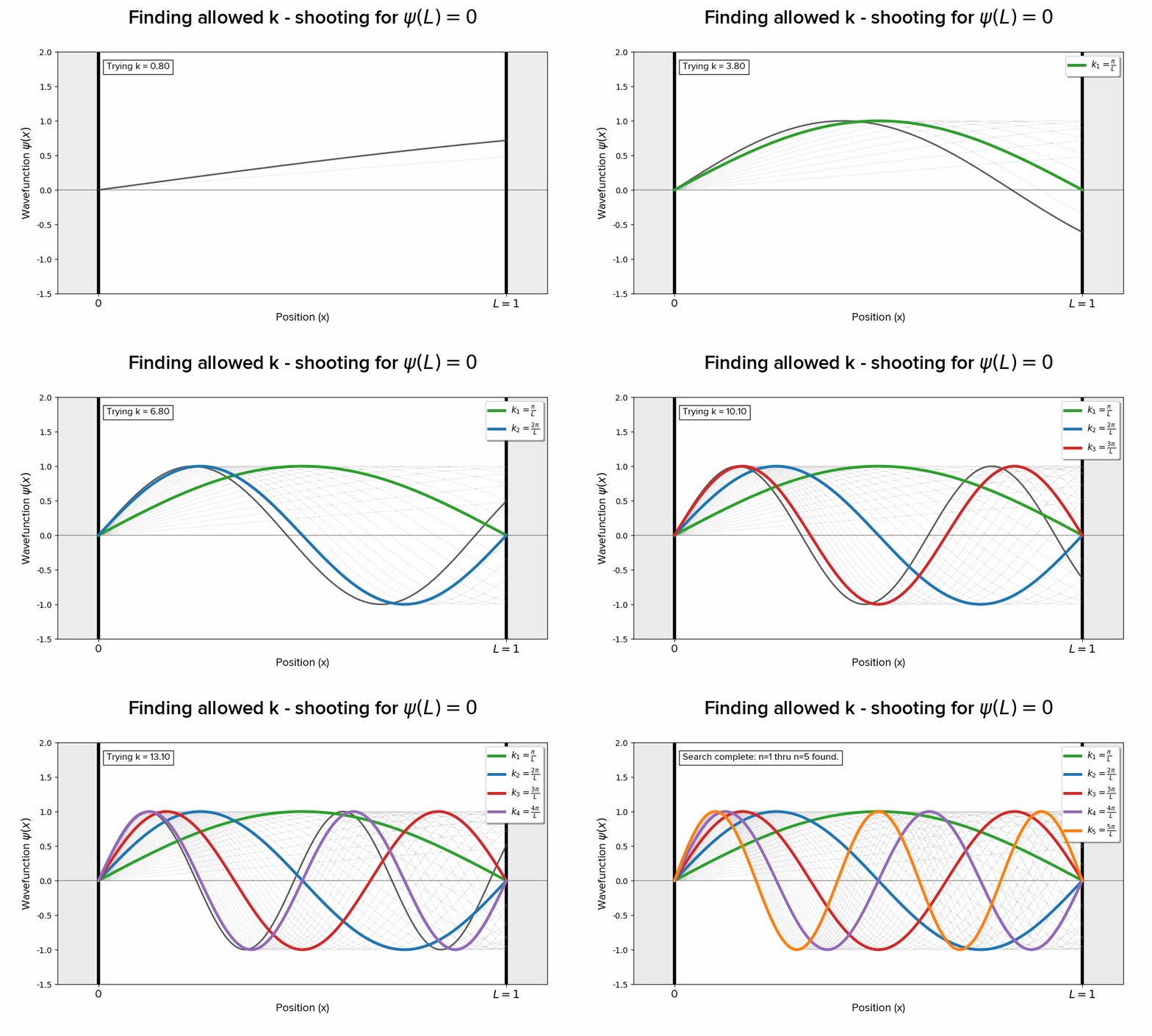
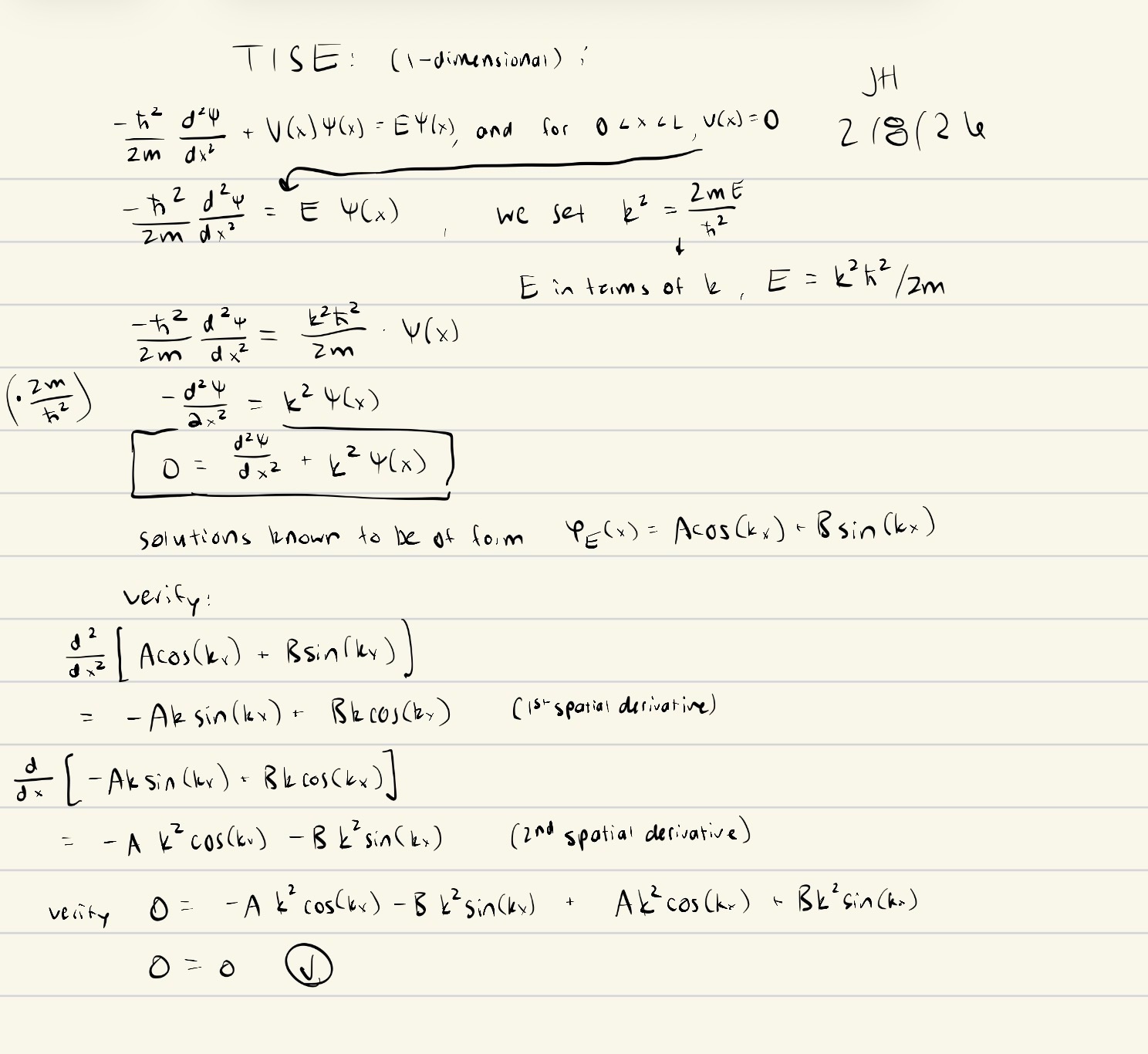
I have my work briefly summarized on this page. Where ϕ(0) = 0 forces A to 0, leaving only the sine term to survive, he posed walking through values of k until we find those very special values of kL for which we hit 0 at position L.
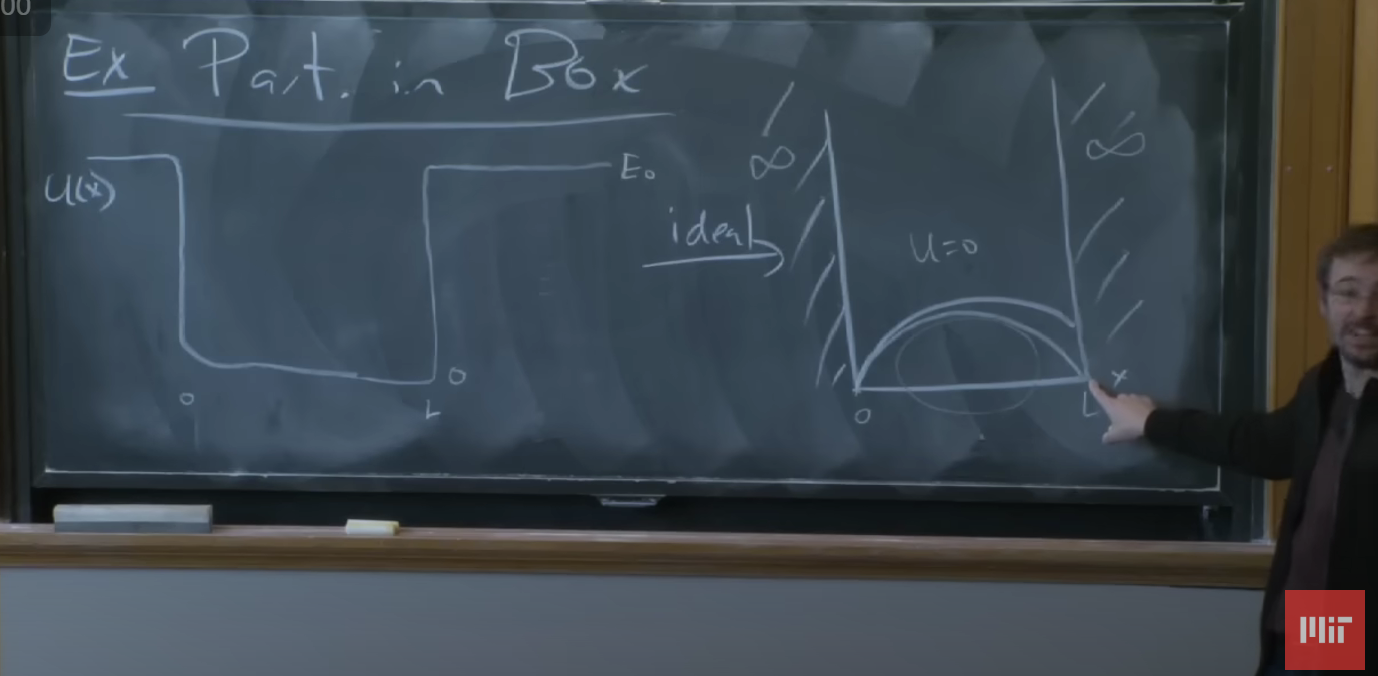
I found it really cool that even in the most trivial, idealistic, simplified example of solving the TISE, we’re faced with the peculiar fact that energy [eigenvalues] are discrete and greater than zero.
This is not an actual attempt at numerical solutions of these problems and uses a rudimentary shooting method — the Python script increments through k values in steps of 0.3 (chosen so there’s about 10 steps between solutions) until it lands on a candidate solution, then switches to a bisection algorithm that I most certainly didn’t write myself. I am definitely not the first to do this, though I do think I am the first to clean it up nicely in a gif. There are multiple people who have treated this more robustly than I have (this Bachelor’s thesis from Austria, this guy’s YouTube video on numerical methods for this exact topic). I will probably try to follow this with a similar visualization of the simple harmonic oscillator, as those failed solutions explode (diverge) at infinity which is a much more dramatic visualization for how our energies are forced to discrete values. The math is much more complicated and I don’t know how I’m going to do that.
Leave a Reply