Every graphic I saw online was either outdated or didn’t go back far enough, so this is my attempt to put a more comprehensive one out on the internet. They debuted in 2000 and here I have 2007 through 2025, I will update as I find old ones in the woods. The 2025 ball is now released to market but the image is from Titleist’s media release here. Titleist, if I need to take this down please email me.
It is very difficult to hit a ball over the net at Top Golf
For you, me, and anyone you know who is a long hitter, absolutely not.
For anyone you know who plays professional golf, still probably not.
For a long-hitting pro golfer, from the top floor, using a ball superior to a TopGolf ball, it’s possible.
For a competition-level long drive competitor, it’s very possible with a TopGolf ball
Below is an example of the model – many more included under ‘Results’
This is all based on a linear model I have relating the speeds / spin of TopGolf balls to regular balls from data I took at my own swing speed – this is limited in nature and probably fails to describe extreme conditions well (e.g. swing speed of 150mph)
Assumptions:
TopGolf dimensions are 250 yards to the back of the net, which is 150 feet tall
These are perfectly straight drives and all spin is backspin
We are hitting TopGolf balls, unless specified otherwise – TopGolf balls do NOT launch / fly like regular balls!
We are at sea level, unless specified otherwise
TopGolf balls have similar aerodynamics to regular balls
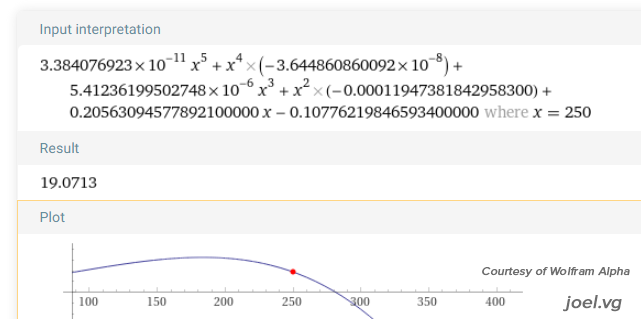
The ball’s flight function was solved for the output when x = 250, i.e., input x being distance, and output returning the ball’s altitude (in yards) at that distance. TopGolf nets measure 50 yards high at 250 yards, so if f(250) > 50, the ball will clear the net
I have no idea how to pull functions out of Excel so there was a messy step where everything was fit to a polynomial regression function, in the end the impact from this was negligible
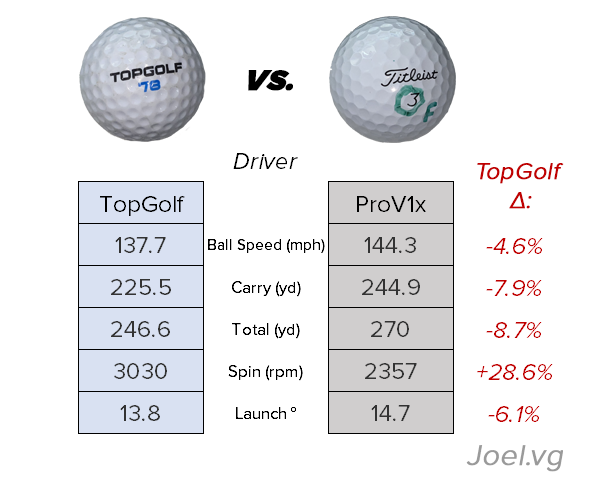
TopGolf balls do not behave the same as regular golf balls. Based on Trackman 4 data I reported here, off driver the ball speed is 4.6% lower, launch is 6.1% lower, and spin is 28.6% higher. These data match my anecdotal experience at TopGolf. Simulations will be ran using these modified numbers, as these changes in trajectory have a significant impact on distance and apex, and thus the potential to clear the TopGolf net.
I used the data above to make a simple, linear model relating regular balls to TopGolf balls. This linear model assumes a constant, proportional relationship between the performance of the two classes of golf balls. In reality, I think at extreme swing speeds / launch conditions, factors like material deformation and aerodynamic drag will not be captured by what I do here. Does a TopGolf ball’s dimple pattern lead to more drag and shorter flight than, say, a ProV1? I suspect so but don’t have any data to back that up.
Long drivers routinely get ball speeds >220mph, so it may be a bold assumption that my data at ~150mph describe the relationship well. Some more complex model underlies the relationship of these balls that I don’t have the ability to describe.
It’s unclear what the dimensions of an average TopGolf are. Some sources describe length as 215 yards, some say 240, some say 250, and some imply 267. With the lack of clarity I’ll assume 250, which is one of the more commonly reported figures online. Most sources agree on a 150 foot fence height. One source quoted a TopGolf spokeswoman at a 170 fence height.
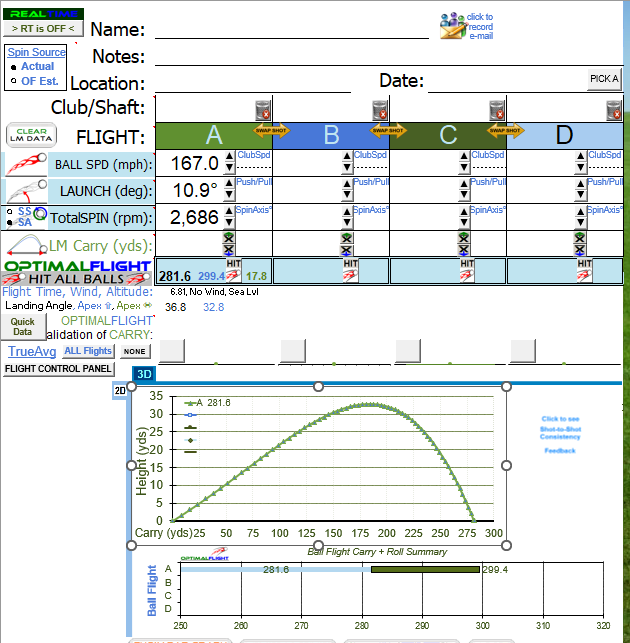
An example of the average PGA Tour driver’s parameters being modeled into a trajectory using OptimalFlight.Solving the polynomial fit to our model’s ball flight, where f(250) returns the ball’s altitude in yards at 250 yards distance. For this shot, it was approx 19.1 yards, which does not clear the 50 yard net.
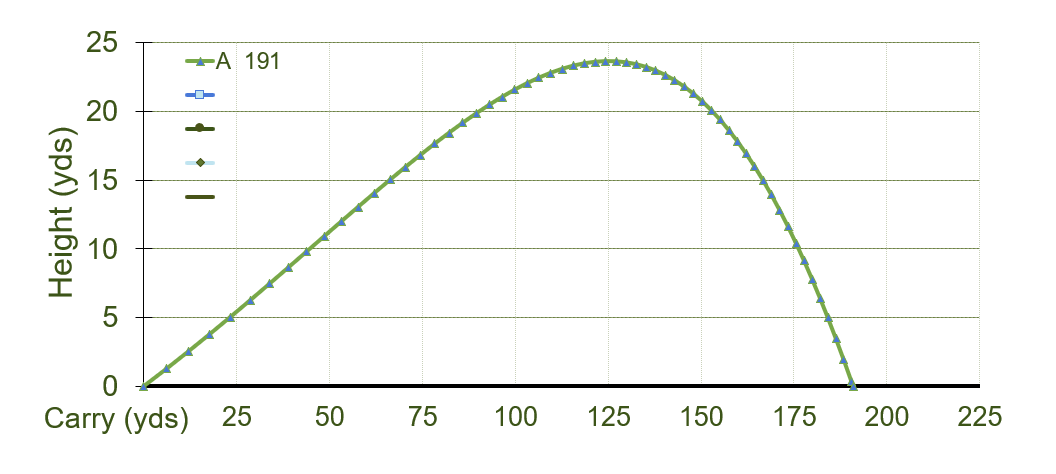
His ball intercepts the net at 10.0 yards of height. Closer!
His ball intercepts the net at 10.0 yards. It would have carried 263.2 had its flight not been obstructed (remember – this model uses a TopGolf ball)
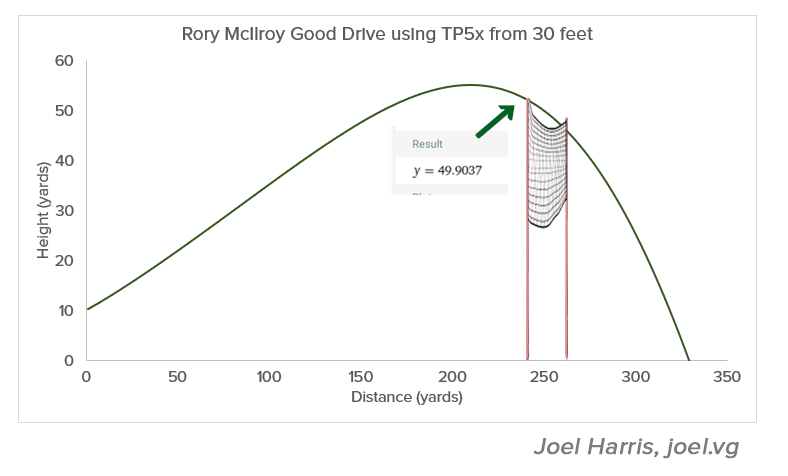
Typical / good drive from Rory McIlroy:
As of March 12th, 2023, Rory’s average driver ball speed in competition is 184.6 mph. In 2017 Rory tweeted his launch monitor numbers, including a ball speed of 184.1 mph, so I think this is a good enough approximation of his current average. This likely represents a better than average strike given the carry and total.
Ball speed: 184.1 mph → 175.6 mph with TopGolf ball
Spin: 2523 rpm → 3245 rpm
Launch: 12.5° → 11.7°
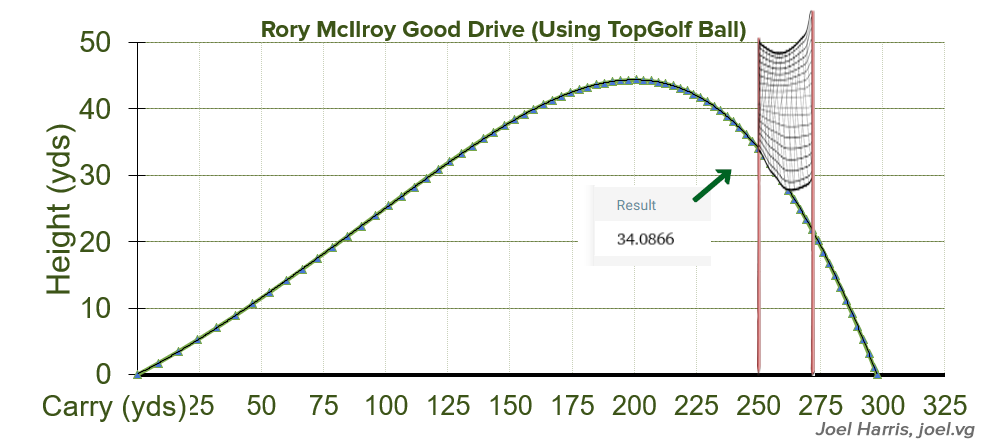
His ball intercepts the net at 34.1 yards of height. The first to threaten it!
This shot would have carried 297.9 had its flight been unobstructed. Had it been a normal ball rather than a TopGolf ball, this carry would have been 320-330 at sea level.
OK, What if Rory brought a TP5x or ProV1 to TopGolf and hit that, and he’s also on the 3rd floor??
Same input parameters as above, I just did not apply the speed / spin / launch penalties of a TopGolf ball
184.1 mph, 2523 rpm, 12.5° launch
I made the assumption that the hitting surface of the top deck is 30 feet from the ground level. It may be higher but I do not have any numbers on this.
Just mere inches short!
Just a hair short of the 50 yd / 150 foot net! As a reminder, the graphic of the net is just a quick addition in Photoshop – the true answer comes from solving our polynomial regression for f(250), which in this case was 49.9 yards.
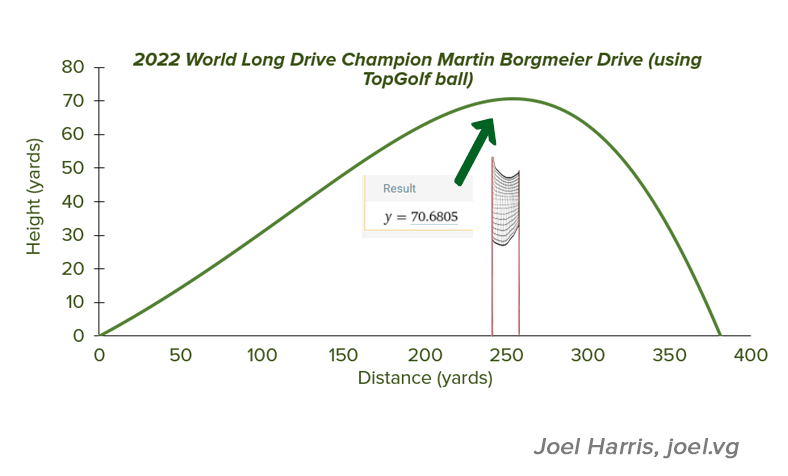
Great strike from 2022 World Long Drive Champion, Martin Borgmeier:
TopGolf balls do not go as far as typical golf balls
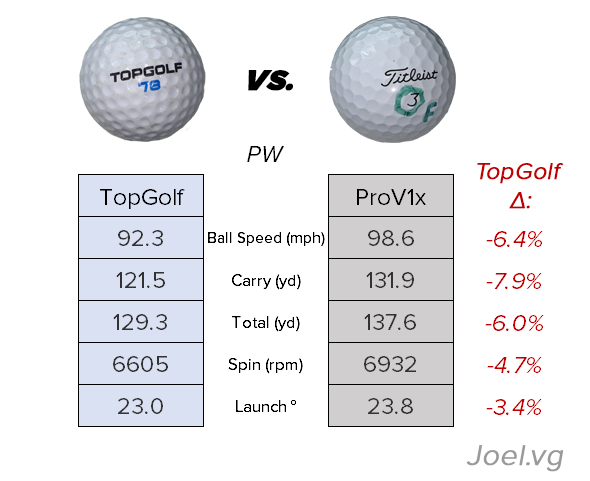
For me, carry distances were down 8%
There are multiple reasons why it is advantageous for them to do this
Methods and materials:
The $20,000 behemoth (that can somehow be rented for $30/hour!?!?)
Trackman 4 was used, indoors, with about 12 feet of unobstructed flight. All data were normalized to sea level and 75 °F.
A single TopGolf ball was used, which certainly limits the validity here. For what it’s worth I did not steal it, for some reason my driving range has a few random TopGolf balls that occasionally find their way into our buckets. So I guess I did steal it, just not from TopGolf. Regardless, I plan to throw it back on the range next time I hit a bucket to alleviate this crushing weight on my conscience.
A RCT ProV1x was used (what is RCT?), as this was Trackman and it’s difficult to get spin readings without a RCT ball.
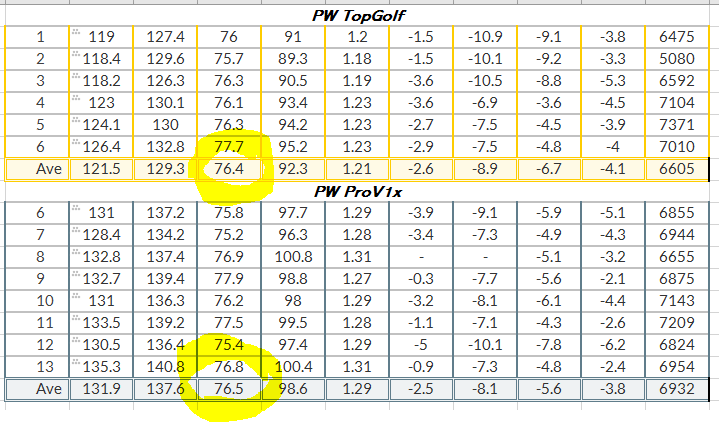
To ensure the ‘input’ was close enough to make a fair comparison, I ensured clubhead speeds were equivalent in both groups. I excluded several early PW shots as there was a warm-up bias where I was swinging a few mph slower at the beginning of the session. After the exclusions, the clubhead speeds were nearly identical at 76.4mph and 76.5mph in the two groups. Club path, face to path, and angle of attack were consistent within the groups as well, as AoA especially would influence backspin. I excluded one data point from the driver ProV1x data, where I swung a few mph faster.
Limitations
There was only about 12 feet of unobstructed ball flight for Trackman to read. Of note, Trackman gave me several italicized spin numbers with TopGolf balls (italics means spin was not actually measured but only estimated based on impact conditions – i.e., italics = less accurate – more info here) I did not get any italicized parameters with the RCT ProV1x.
This means the spin accuracy is questionable. Indoors, this is difficult to avoid. As discussed above, I only had one TopGolf ball to use.
Discussion
Results can be seen in the images at the top of this page.
This provides context to the observation that many of us have made when we go to TopGolf, which is that it feels like the ball doesn’t go anywhere.
Results reflect what I have seen in many range balls, which is more spin off of woods, less spin off of irons or wedges. Had I hit my 56°, I suspect spin would have dropped from 10,000 to something like 8,000 rpm. A slight penalty on ball speeds as well. Anecdotally, I have seen about a 5% ball speed dropoff from range balls to TopGolf balls, however I’ve never had the chance to compare a premium ball to TopGolf.
I find this information useful because it plays into the argument of whether one can drive a ball over TopGolf’s back net. I hope to follow up with another post on that, but the limited flight of TopGolf balls becomes quite relevant here.
Why is this the case?
Golf balls meant for course play and golf balls meant for repeated usage on a driving range have fundamental differences in design. Balls meant for play on a course (we’ll call them “premium balls”) are optimized for launch and spin to provide the best performance. The urethane covers on these premium balls, while providing the best trajectory and spin profile, are soft and cannot stand repeated impacts. Balls for driving ranges (and TopGolf) are built less for performance but instead for survival – they have essentially the hardest, most durable covers feasible, to ensure their survival over thousands of impacts. For some driving ranges, balls are replaced annually or even less often.
In addition, premium golf balls’ cores are once again designed to optimize launch and speed. TopGolf balls require the inclusion of an RFID chip in their plastic core (see image below!). This foreign, non-homogenous core almost certainly is less efficient than a normal core, and ball speeds will take a hit compared to balls that do not necessitate the inclusion of chips.
Finally, it suits TopGolf from a business perspective to have limited flight golf balls. Even without RFID chips, some driving ranges choose to use limited flight golf balls, which are designed to be slower, to save space. Driving ranges with real estate limitations use these often. A TopGolf range is expensive to construct, and needing 250 yards of range and fencing saves costs over a 350 yard range, which might be typical for a normal driving range.
Inside of a TopGolf ball. Credit to Reddit user “u/JamberoniIcedTea” for image